Senior dog home guide
Why is my old dog having such a hard time getting out of bed?
Pain can make getting up difficult. A sliding bed, a high edge or a slippery floor can add to the struggle. Watch where your dog gets stuck before buying a replacement.
In this piece
Does your dog struggle to stand, or stand quite well and then get stuck climbing out of the bed? The distinction can save you buying another expensive bed with the same awkward edge.
Pain can make getting up difficult. A sliding base, a high bolster or a patch of bare floor can add another obstacle. A new or worsening struggle deserves a vet appointment. While arranging that, look at the exact part of the morning that has become hard.
Watch the feet, the bed and the first step out
Watch the next time your dog gets up naturally. Don't keep calling them up for another attempt. Notice whether the bed shifts, a paw catches or the first step lands on a slippery floor.
| What you notice | What to check at home |
|---|---|
| Trouble turning or getting feet underneath | Usable space and whether loose covers gather underfoot. |
| A paw catches while leaving | The height and shape of the entrance. |
| The bed moves during the push to stand | Whether the base stays steady on this floor. |
| Feet slide just outside the bed | The landing spot, including gaps between rugs. |
| Difficulty continues after leaving | Tell the vet it extends beyond the bed. |
That is an observation guide, not a diagnosis. Don't force a movement or pull your dog up to complete the list.
The rug can miss the one spot that matters
An owner of a 15-year-old dog described slipping on hardwood and trouble getting up after lying down. Rugs and stair treads were already in place, but gaps remained. They were wondering about booties. Read the hardwood-floor discussion.
Follow your own dog's usual exit toward breakfast or the outside door. Check where the front feet land, where the hind feet follow and whether a mat stays flat. One uncovered turn can make a well-rugged room awkward.
Canine Arthritis Management's home checklist considers bed access, support, loose bedding and nearby footing. A low entrance may be useful for a dog who catches a paw. It won't explain a dog struggling to stand on every surface.
Before replacing the bed, measure the inside
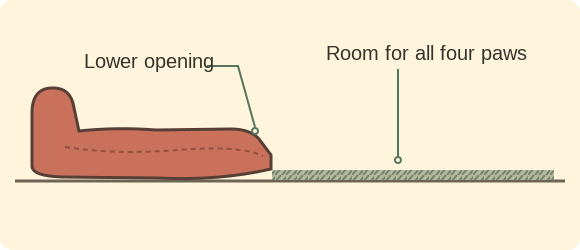
The advertised dimensions may include thick bolsters. Measure the area your dog can actually lie on, plus the room available to turn and leave. Photograph the current bed and surrounding floor.
I would prioritize a manageable entrance, a steady base and room to reposition over another promise of luxurious softness. Watch whether your dog sinks into the current surface and has difficulty moving. Check cover fit and the return policy on a replacement. Ask the clinic what support suits your dog's condition if the choice is unclear.
Hard to get up everywhere? Tell the vet that.
ACVS lists difficulty rising, stiffness and reduced activity among signs of osteoarthritis. Other problems can look similar. Use what you naturally see during the day: is your dog also slow to rise from a rug or another usual resting spot?
If an arthritis plan is already in place, report the new difficulty anyway. The bed may need changing, the treatment may need reviewing, or both.
A short clip is more useful than another painful demonstration
The AAHA senior-care guidelines support home mobility videos and photographs of the sleeping area. If you can record a normal rise safely, include the bed and first steps. Don't delay helping your dog to get footage.
Write down when the problem started, where it happens and what help is now needed. Include recent changes in treatment or the setup. A note such as "the bed slid, then she walked comfortably on the rug" gives the clinic a specific movement to discuss.
When the bed shopping can wait
Sudden inability to stand, new limb weakness, severe pain or trouble passing urine needs urgent veterinary advice. The ACVS disc-disease guide describes serious spinal warning signs. Get help rather than asking for another attempt.
For a gradual change, arrange the assessment and check the landing beside the bed. That is a small, useful place to begin while you find out why mornings have become harder.
Sources
- Read the hardwood-floor discussionreddit.com
- Canine Arthritis Management's home checklistcaninearthritis.co.uk
- ACVS lists difficulty rising, stiffness and reduced activity among signs of osteoarthritisacvs.org
- AAHA senior-care guidelinesaaha.org
- ACVS disc-disease guideacvs.org